‘Owning a record? There’s nothing like that’ – Paul Deacy of Bell Book and Candle
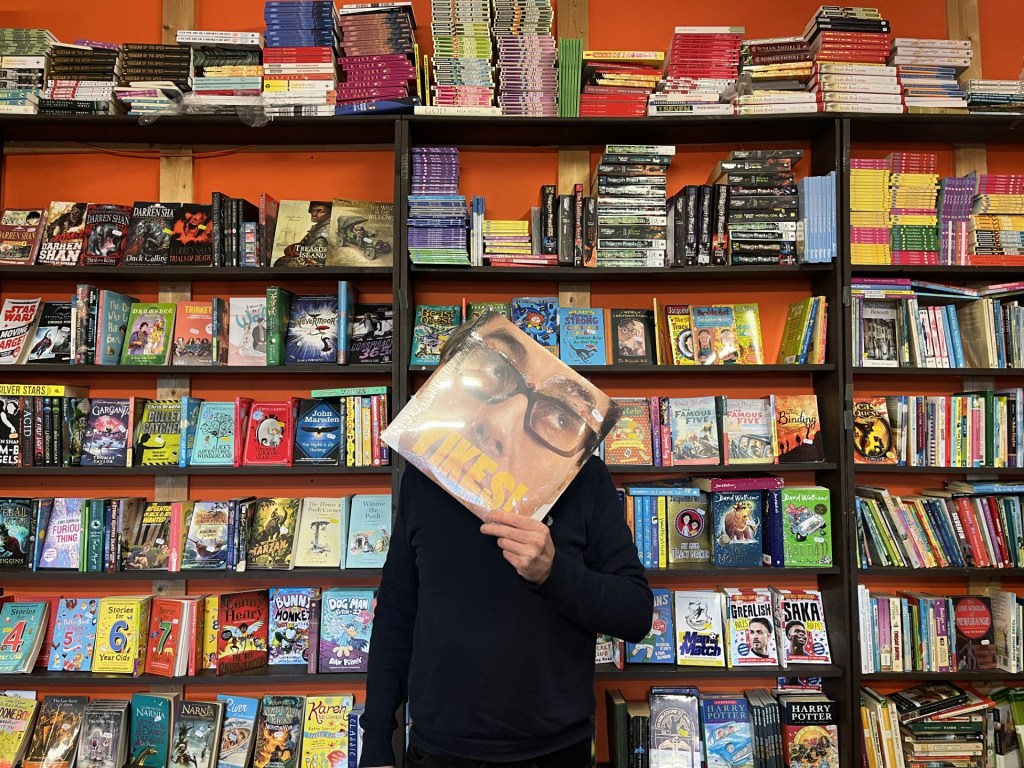
Paul Deacy, owner of Bell Book and Candle. Photo: Maureen Arnold
By Maureen Arnold
As I enter Bell Book and Candle on a brisk autumnal evening, a group of young adults with guitars strung across their backs are making their way out of the shop, one sticking around to chat with its proprietor Paul Deacy about The Cocteau Twins, as the Scottish dream-pop band’s 1990 LP Heaven Or Las Vegas is playing through the speakers. Deacy recommends the young man explore the group’s lead vocalist Elizabeth Fraser’s discography further, suggesting with urgency that he delve into her solo work as well as her collaborations with trip hop collective Massive Attack.
Bell Book and Candle, named after the 1958 film starring Kim Novak and James Stewart, carries a variety of goods, from used books of any genre to historical Galway memorabilia to stacks of CDs and crates of vinyls and cassettes.
The shop resides in Galway’s west end just beside the Crane Bar – the ideal neighbour pairing for any Galwegian music junkie. The shop is perfect for locals on the search for an expansive catalogue at reasonable price-tag. “Not to push my business, but truthfully, I sell CDs and records for quite cheap,” Deacy states. “A majority of those buying them up are school children and students looking for an affordable option.”
He doesn’t remember the exact year Bell Book and Candle opened its doors, but he assured me it’s been around over 25 years.
The Shift from Streaming Services, Back to Traditional Media
Within the last year, there has been a significant shift in the conversation regarding media consumption, specifically on the ethics of music streaming services. With morals put into question regarding how artists are compensated for their work, the use of AI and streaming services giving platforms to organisations such as United States Immigration and Customs Enforcement (ICE) for recruitment advertisements, more consumers have shifted back towards traditional music consumption, such as physical media.
Deacy has made notice of this movement in his own shop. “I’ve definitely seen a change in recent months,” he reflects. “It’s very hard to listen to a song that you really like and realise that the person who made it is going to get like a fifth of a cent or something from that listener. So eventually people are going to feel a slight bit guilty about it.”
“Downloading something is grand, but owning a record? Having a piece of a band you love that actually belongs to you? There’s nothing like that. It’s such a nice feeling to support someone in that way.”
Deacy’s Catalogue
A quick peek around the collection reflects a broad scale of genre diversity, with records from the likes of Tori Amos to Elton John to John Mellancamp. The catalogue refuses to discriminate, and he tells me his own private collection similarly reflects this.
The first album he ever remembers purchasing was Dire Straits Brothers In Arms, released in 1985, though he revealed this admittance comes reluctantly.
Deacy suggested perhaps the revitalization of buying physical media might have something to do with the search for “nostalgia”.
His face lights up when discussing his origins with music, sitting around on a rainy Sunday with his family and playing tunes on the record player, which he says “lived in its own room.”
As he grew older, he attempted to shift away from his parents’ taste as a form of rebellion.
“We decided we didn’t like Rock N Roll because our father did,” he said, speaking about him and his sister.
“We’d dedicate full days in Dublin just to go around to all the record stores. It was kind of a social thing as well, learning about music from your peers and connecting with other fans in that way.”
“Before things were as accessible as they are today, going out and seeing gigs live also played a huge part in curating your own taste.”
Nowadays, Deacy said he doesn’t get to live shows in Galway as often, though he ventures over to the Roisin Dubh and Monroes when he finds the time.
“I also like to recommend music to people who come in, see if I can test my read on them,” he said with a smile.
“I get recommendations from customers sometimes too,” he laughs. “But that doesn’t mean I follow through with the actual listening part.”
I recalled purchasing the Magnetic Field’s 1999 LP 69 Love Songs from Deacy in July, to which he offered an affirmation of his approval with a smile and nod.
Creating a Platform for Local Acts
Deacy also offers a platform to local music, dedicating a section of his vinyl collection to Galway-based record company Blowtorch Records. He tells me his recommendation from the label are GOPNIKS, an alt-rock band who’s debut album The Blah Biz Cabaret, was released in May.
He tries to give small local bands as much representation as possible, though he confesses the competition with major labels can be quite stiff.
“It’s hard to get people to pay for things they’re not familiar with, so it can be difficult for bands just starting out.”
Deacy proposes a substantial supporting grant for artists from the government, to further nurture their craft, beyond the existing Basic Income for the Arts Scheme.
“People deserve to be paid and supported, and people will have to come to terms with the fact that good entertainment doesn’t come for free. That’s the way to cultivate a local scene.”
Bell Book and Candle is located in Small Crane just beside the Crane Bar and is open Monday through Saturday.