Can the Aran Sweater Survive Another Generation?

Ann Day is keeping the Aran Sweater tradition alive from her home on Inisbofin
By Amy O’Connor and Kerrie Gardiner
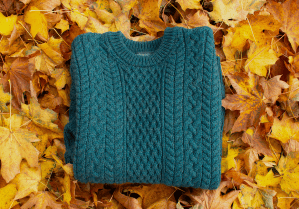
When you walk into one of the many tourist shops in Galway, you’ll find rows of perfectly folded cream jumpers with their familiar cable knit patterns, ready to be taken home as a little slice of Ireland. However, out on Inishbofin, Ann Day is keeping the Aran sweater tradition alive in a rather different way. Armed with her trusty pair of needles, she is producing unique, freehand Aran sweaters that have stood the test of time.
Back to the Beginning
Now in her eighties, Ann learnt the ropes as a young girl, following the tradition passed down in her family for generations. “I started at six with my mother,” she recalls, describing how her mother would spin sheep’s wool while she learned to knit alongside her. She explains that her mother had given her a pair of her old needles, but the novelty did not last long. “I’m going to take those knitting needles off you now, because if you get cross you might bore somebody!” Ann laughs, as she recalls her mother’s reasoning.
Her next pair after that was far from conventional, fashioned from two goose wing feathers. “They were perfect,” Ann sighs, recalling the unusual needles that introduced her to a skill she has never lost.
Worldwide Success
Ann’s sweaters have found homes across the world, with some customers continuing to wear jumpers that are over 40 years old. She recalls a moment three years ago when two separate customers admired the longevity of her work.
Shocked to see a French lady she didn’t know donning a knit that was unmistakably her work, she questioned her. “What are you doing with my pattern on your sweater?” she asked the woman. “Well you made it,” the lady laughed. It turns out that a woman Ann worked with on Inishbofin had brought the jumper to a friend in France as a gift. “And it’s still perfect, absolutely perfect,” Ann says.
That very same afternoon, another man visited her cottage to tell Ann that he had been wearing a jumper she knitted for 30 years. “Well, I feel rewarded!” Ann remarks.
For Ann, this is what distinguishes traditional knitting from the growing number of machine-produced alternatives. She believes that both the quality, and the detail of a handmade sweater set them apart, arguing that the patterns on machine-produced sweaters do not have the same definition, and that she can always tell when a sweater has been made by a machine. “They obviously don’t last as long either,” Ann comments. “But I tell [my customers] what to do, and how to take them off. Never pull your sweater by the back of the neck, because you’ll destroy the neck. If you take care of your sweater, an Aran sweater is one that will live for a long, long time.”
Ann’s Fundraising Efforts
However, Ann’s contribution to her island extends well beyond her knitting. For the past 43 years, she has collected money for the local lifeboat service, raising funds to support the volunteers who respond to emergencies at sea.
During the Summer months, she opens her home to visitors, displaying her sweaters and giving people an opportunity to contribute to the fundraising. Nearly 12 years ago Ann received an award for her fundraising efforts. “Of all the islands of Ireland and the British Isle, we got it here.” She explains how she travelled to England to accept the achievement with her nephew and was awarded by the Duke of Gloucester: “Inishbofin? They didn’t know anything about it!”
Looking Forward
Despite her dedication to the craft, the future of traditional knitting weighs heavily on Ann’s mind. Ann remembers a time when knitting was taught in schools and passed naturally from one generation to another. She worries that fewer children are being introduced to the craft today. “My sister does knitting too, but I mean, what’s going to happen when we go? Who’s going to make all the jumpers?” she wonders.
This raises questions about the growing popularity of cheaper, mass-produced Aran sweaters, particularly with younger consumers. For some shoppers, affordability and convenience may take priority, but the time and skill involved in producing a traditional, handmade sweater can be easily overlooked.
Ann’s own passion has never faded, as she still spends every evening knitting while watching soap operas, insisting that she wouldn’t be herself without it. “I’d cry if I didn’t have my knitting,” she says.
Having started with two goose-wing feather needles at just six years old, Ann has spent a lifetime keeping the tradition alive. With customers continuing to return and new orders keeping her busy, she has no plans to put down her needles just yet. For her, the value of an Aran sweater is not only in how it looks, but in the hands and history behind it.
The Aran sweater itself may be in no danger of disappearing from the shelves, but the tradition behind it is another story. As fewer young people learn the skill of hand knitting, Ann’s question remains, who will be left to pick up the needles?