An Ghaeilge and its importance to Irish Identity – Bríd Ní Chonghóile
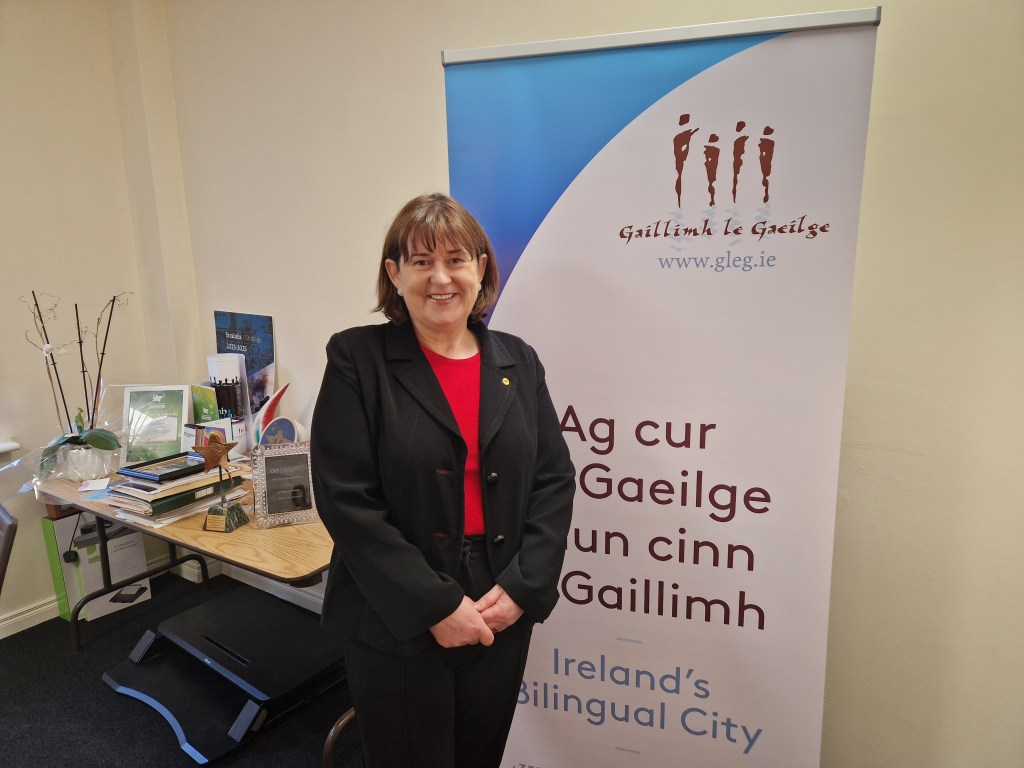
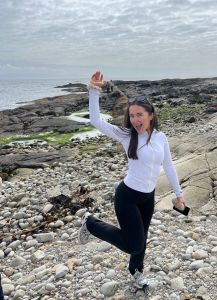
An image of Bríd Ní Chonghóile, CEO of Gaillimh le Gaeilge
Bríd Ní Chonghóile is the CEO of Gaillimh le Gaeilge (GLEG). GLEG is an Irish language organization based in Galway City. They promote the Irish language in many sectors, working particularly with businesses. Established in 1987, its work includes increasing the visibility and use of the Irish language through initiatives like bilingual signage, websites, menus, and more. It also organizes events such as Lón Gnó (business lunches in Irish to encourage people to speak Irish) and runs programs like Gaeilge sa Ghnó, Gradam Sheosaimh Uí Ógartaigh, Galway’s Bilingual Business Award, to encourage businesses to adopt Irish in their daily operations.
Their most recent project is a bilingual festival Tonnta. Next year it runs from 30th January until 2nd February 2025. The programme will feature diverse performances, celebrating the Irish language and Galway as a bilingual city. With the help of Irish speakers and various bilingual cultural activities, GLEG aims to introduce more non-Irish speakers to the Irish language. It also celebrates and showcases the vibrant and unique Gaeltacht culture as well as the legacy of St Brigid. I spoke to Bríd to gain insight into her relationship with the Irish language and what makes her passionate about the work she does with Gaillimh le Gaeilge.
Bríd’s background in the Irish language
Bríd was raised in a Gaeltacht area in Northwest Mayo called Ceathrú na gCloch (beside Ceathrú Thaidhg). Irish is her first language; she attended a national school in her village (all the subjects were in Irish) and a boarding school through the medium of Irish in Tourmakeady. She learnt English from her English classes in boarding school saying, “My English teacher was excellent, she had a great way about her and epitomized everything that was English”. Bríd also learned English from some of her friends at boarding school but never felt like she was most comfortable speaking English. She said, “Even to this day, if I’m giving a presentation, I have to start in Irish first, it grounds me”. The Irish language seems as if it is woven into Bríd’s being.
Bríd then came to Galway to study in the University of Galway. She studied Irish, Political Science, Archaeology and History. She says, “I met my tribe there, I met people from other Gaeltacht regions, and many Irish speakers came to Galway because they could do their subjects through the medium of Irish.” After she left university, she “did a few different jobs, but the language was always connected in some way.”
Bríd’s work with Gaillimh le Gaeilge
Bríd never said specifically that she wanted to work solely with the Irish language or in an Irish language organization. She worked a few jobs related to the Irish language, Conradh na Gaeilge and on stage in An Taibhdhearc. Then a position came up in Gaillimh le Gaeilge as a festival coordinator and she took it. Bríd feels that because the Irish language is a part of her identity and is what she loves, it drew her to the path she took with Gaillimh le Gaeilge. She loved working on the International Pan Celtic Festival, “I found working with other minority and Celtic languages very interesting, exchanging ideas with participants and artists and it also created a great but different buzz in the city”. After working as a festival coordinator, she worked part-time as a project officer.
After a year, her uncle, a key member of Bríd’s family passed away and she had to go home to work in the family pub to keep the business going and support her family. At that time, Bríd’s chairman, Dr Peadar Ó Flatharta, was very understanding of her situation and said, “Take all the time you need”. This cemented Bríd’s desire to work for Gaillimh le Gaeilge, as it showed her that both the values of Peadar and the organization were values that she too admired. Now Bríd has been working for GLEG for almost 30 years.
Bríd’s relationship with the Irish language and identity
When asked about her relationship with Irish now, Bríd said, “It’s me, I’m Bríd Ní Chonghóile, not Bríd Connolly you know? It’s just part of who I am”. This is fascinating as attitudes towards the Irish language are changing, and people are discovering its importance in our cultural identity. It connects Irish people to the ground we walk on, Bríd quotes in Irish, “tír gan teanga, tír gan anam.” Meaning a country without a language is a country without a soul. And this is what makes Bríd passionate about the work she does with GLEG. Irish is woven into her being and she wants to share this “Grá” for Gaeilge while at the same time making Irish more accessible to other people who may not have had the opportunity before now.
Bríd encourages people who want to get back into learning the language to immerse themselves in it, “listen to Irish podcasts, RTÉ Raidió na Gaeltachta or watch Ros na Rún or TG4”. Referring to my own desire to learn the Irish language, she says, “If the passion is there, you can do it, I know you can”. She speaks about how the Irish language is ‘fite fuite’ (intertwined) it helps us to feel connected to our art, traditional music, literature, our placenames and of course our ancestors. “Because I speak Irish, I feel more connected to my forefathers – I have a special connection to those who came before me.” She emphasizes the significance of this connection. She says if people want to feel that connection as well, to just “go for it.” This shows how important the language is to her and what makes her passionate about the work that she does, connecting us all to who we are, it’s in all of us “fite fuaite”, some of us must dig a little deeper, to use and embrace it.