“I knew something terrible, awful had happened, but it wasn’t really hitting me.” Joe Loughnane on Adam’s Protocol and the HSE

By Emma van Oosterhout and Tara McGivern.
Readers are warned that this article is about suicide and loss, please read with caution.
Joe Loughnane was still reeling from the shock of his brother’s death by suicide when he was told something that turned his grief into something else.
“Another doctor came up to us and said, ‘Look I need to say something to you’. [The doctor] said ‘I know you just received the worst information possible, but we have to be honest with you, he was actually in here a couple of hours ago.”
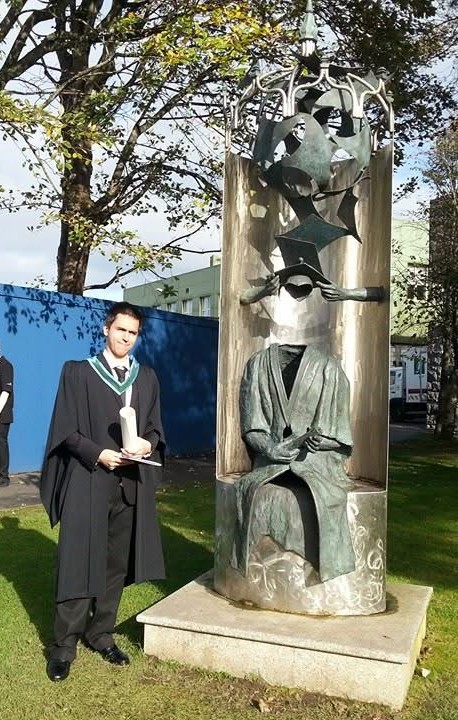
Adam Loughnane was just 34 when he died by suicide on 11 February 2025. Described as a “highly intelligent young man” by his older brother, he had gotten 600 points in his Leaving Certificate and a first-class degree from University of Galway, but had been living in emergency accommodation at the time of his death.
On the day of his death, Adam followed procedures and guidelines as set out by the HSE: he called his support worker, telling her he wasn’t feeling great. Having spoken to the local mental health unit, she then drove him to the emergency department at University Hospital Galway. His social worker could not accompany him inside she could not find parking. Adam entered the emergency department at about 1:50pm.
Adam was triaged as a ‘category two’ patient, according to the Manchester Triage System, meaning he needed psychiatric help within ten minutes as his condition was life threatening.
Adam left UHG’s emergency department at 4.06pm, according to Hospital CCTV, having not been attended by staff for over two hours with the overnight bag he had packed before attending the hospital, under the presumption that he would be admitted for a few days.
Adam’s body was found shortly afterwards.
Joe Loughnane, Adam’s older brother, made his way to UHG where he identified his brother:
“It was very much him, and then as we walked out, I suppose that’s what started everything.”
But it was the approach from a second member of staff who told Joe that his brother had, in fact, sought help at the hospital earlier in the day that his grief turned to anger.
“I went absolutely mad […] I said ‘how could this happen?’ and they didn’t have an answer for me.”
Joe has been campaigning for change since, pushing for dedicated mental health to be set up in Irish A&Es for those in mental health crisis, examples of which can be seen in the US, where EmPATH (Emergency Psychiatric Assessment, Treatment, and Healing) units offer a calming mental healthcare setting for patients, away from crowds and noise.
He and his family made the tough decision to go public with Adam’s story in hopes of preventing a similar situation happening again:
“When we went public with Adam’s story some families said it to us. They said, ‘Are you sure this is the right thing?’ and it was me who made the decision.”
“I said it to my mum ‘people will just forget about him if we don’t say something here’, it will just be an inquest and then an apology and it will just be forgotten about, unless were willing to go public and say ‘look this has happened to us, to my brother’.”
“[If we weren’t to speak up] we’re probably failing a lot of people who are going through the exact same situation.”
“It was actually shocking, when we went public with Adam’s story, the amount of people [that came forward].”
Joe launched a petition which now has over 21,000 signatures.
Last month, Joe brought that campaign to the Oireachtas Committee on Public Petitions.
“I wish I wasn’t here,” Joe told the TDs in attendance. “I wish instead that I was reading some long, whimsical text from Adam, sent into the family group chat. But there is no escaping the reality of losing a loved one to suicide.”
However, Joe says the family do not blame the hosptial staff.
“Our campaign has continuously pointed out that Adam’s death was not the fault of any one staff member. The system failed him. The medical professionals who tried to help Adam are over-worked, under-paid and under-staffed. They can only do so much with the facilities provided to them.”
During his address Joe highlighted serious issues with mental healthcare funding saying:
“In the 2026 [Health] Budget, €1.6 billion out of €27.4 billion (5.8%) was spent on mental health. Once again, less than 6% of the health budget has been allocated to mental health this year.
“This is well below the 10% recommended by Sláintecare and less than half of the 12% recommended by the World Health Organisation.”
In response to a request to comment from Galway Pulse the HSE declined to comment on the specifics of Adam’s case but said it is firmly committed to reducing suicide and self-harm levels in line with the Connecting for Life framework.
“Significant progress has been made over the past three years to develop alternative crisis mental health pathways. In Budget 2026, an additional €15m was allocated for crisis supports and suicide prevention, which will improve support for people in mental health crisis, both in hospitals and in the community,” a spokesperson said.
If you have been affected by the content of this article, support is available. You can contact Samaritans free of charge on 116 123, or email jo@samaritans.ie
If you are a student of University of Galway, you contact the counselling office at (091) 492484 or at counselling@universityofgalway.ie
You can listen to the full interview with Joe here.


1 thought on ““I knew something terrible, awful had happened, but it wasn’t really hitting me.” Joe Loughnane on Adam’s Protocol and the HSE ”