University of Galway Masters Students Visit Branches of EU Parliament
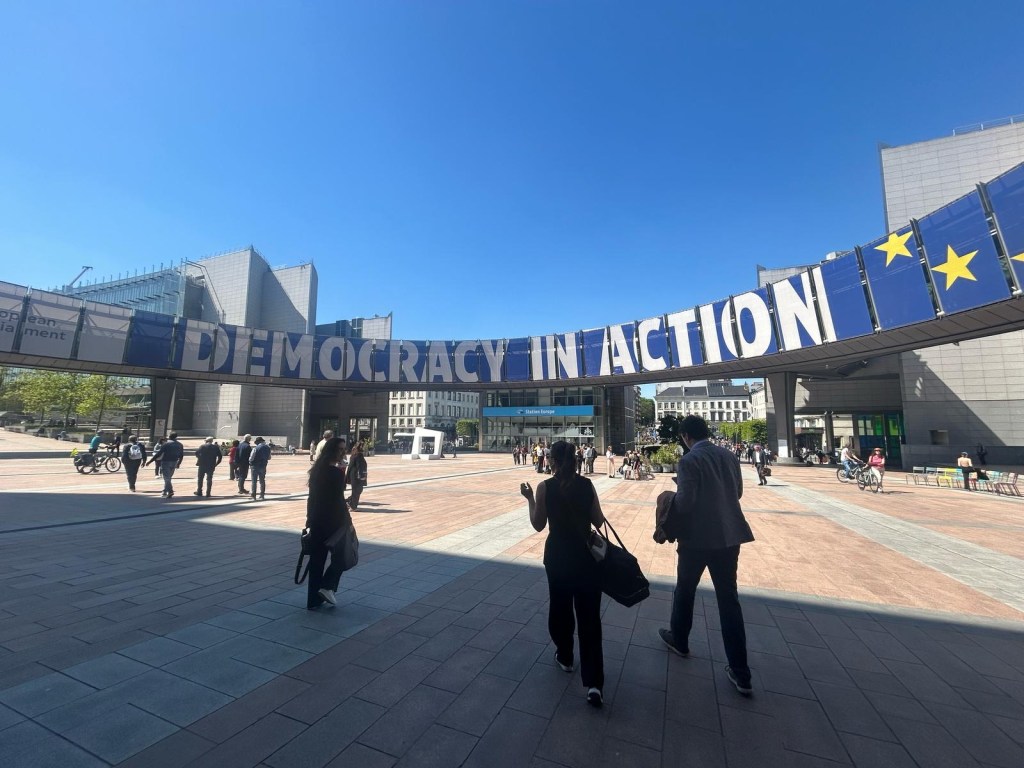
University of Galway’s Journalism and Global Media master’s students visited Brussels late last month, home of the European Union. The group explored the three main branches of the EU: the Parliament, Commission, and Council, with briefings on the future of media in EU politics.
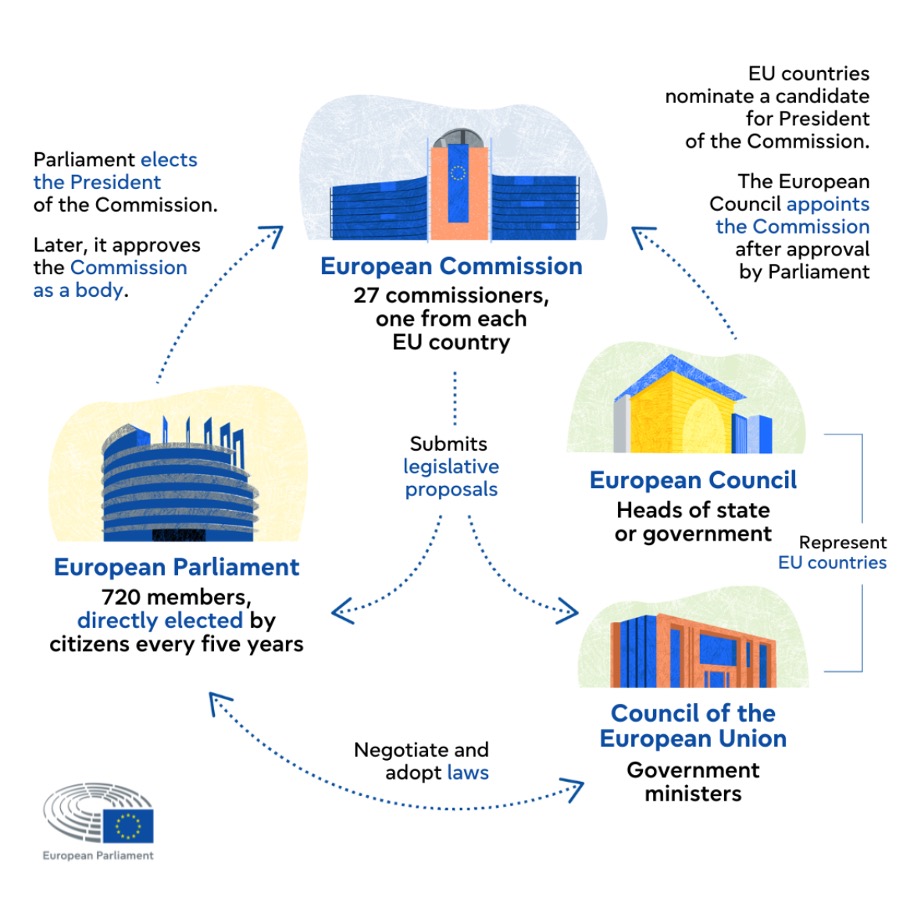
As The Pulse continues to share details from the trip, we break down the structure of the Union to better understand how new media legislation is introduced and enacted.
Parliament:
It’s a humbling experience to look down over the Hemicycle of the EU Parliament, especially as one of only a dozen visitors in the room.
The Parliament has 750 physical seats, though only 720 are currently occupied by representatives from member states. Members of the European Parliament (MEPs) are arranged according to political group, from the furthest left to the furthest right in political leaning. Chairs and co-chairs sit at the front, while other members are arranged in alphabetical order by surname, extending backward.
Distribution of seats to member states depends on a variety of factors, and in 2024, Parliament released their mathematical formula for “determining the EU composition”. This formula led to the current allocation: Germany holds the most seats (96), while Malta, Cyprus, and Luxembourg each hold the fewest (6).
Parliament plays a central role in the legislative process, working alongside the Council of the EU to pass and amend laws. It also serves supervisory and representative functions. MEPs are directly elected by citizens of their home countries to ensure democratic legitimacy. Ireland holds 14 seats in 2025, represented by members of Fine Gael, Labour Party, Fianna Fáil, Sinn Féin, and various independents.
During their visit, students were briefed by a Parliament representative from Malta, who explained the principle of “degressive proportionality”—a system designed to ensure that smaller countries are fairly represented, even with fewer seats. She noted that in some cases, smaller member states do not have enough national representatives to match the seat count of larger countries, reinforcing the importance of this proportional method of allocation.
Encircling the chamber are black glass booths housing linguists who simultaneously translate debates into the EU’s official languages. These interpreters are highly respected for their analytical skills and objective delivery during live sessions.
Students experienced this firsthand during a midday press briefing, where French and English were the primary languages. Using individual headsets, attendees listened to real-time translations of a discussion on recent power outages in Spain and Portugal, as well as opinions on U.S. tariffs impacting the EU.
Commission
The EU Commission is a “politically independent Executive arm” that proposes, manages, implements, and ultimately enforces the legislation following the decisions of the Council and Parliament.
One Commissioner represents each member state. The Commission is currently led by Ursula von der Leyen—the first woman in the role—who was recently re-elected for a second five-year term. Commissioners are assigned portfolios based on expertise, and they work with small personal cabinets for support.
University of Galway students interacted with a European External Action Service spokesperson on an area that affects media personnel in the EU: Foreign Information Manipulation and Interference (FIMI). The EEAS operates under the High Representative of the Union for Foreign Affairs and Security Policy and Vice-President of the Commission known as the HR/VP, currently Kaja Kallas, an appointment from President von der Leyen.
According to the EEAS website, “A strong asset of the EEAS is its ability to work closely with the foreign and defence ministries of the member states of the European Union (EU) as well as with the EU institutions such as the European Commission, the European Council and the European Parliament.” According to the EEAS website.
FIMI looks at the manipulation of media, specifically by other countries in looks of disinformation and propaganda, and how it’s used to spread misinformation. Students viewed content examples, including a video from an alleged European outlet posing misleading comparisons between public healthcare and funding for weapons, aimed at undermining support for Ukraine. While the branding and content of the video looked authentic, it was not commissioned by the outlet itself but manipulated to look as such.
Council/Council of the EU
The European Council comprises heads of state or government—Prime Ministers, Presidents, and similar officials—who provide political direction for the EU. It is not a legislative body. The Council is currently chaired by António Costa of Portugal, who will collaborate closely with Ireland as it assumes the presidency of the Council of the EU in late 2026.
While the European Council sets general priorities, the Council of the EU involves national ministers from each country and plays a direct role in passing legislation. It acts as a crucial counterpart to the Parliament in reviewing and amending proposed laws.
The Council of the EU operates under a rotating presidency, with each member state taking a six-month turn every 13.5 years. These rotations occur in “trios” of three countries working together. The presidency’s role is to organize and chair meetings, ensure smooth procedures, and coordinate with other EU institutions.
In Simpler Terms
· The Commission acts as the “dreamer,” drafting new laws after gathering input.
· The Parliament and Council of the EU function as “lawyers and critics,” proposing and negotiating changes.
· Special committees from both bodies serve as “mediators,” finalizing legislation and pushing it through.
Below is a visual aid in the flow of power and responsibility in the EU Parliament.