First narwhal in Irish history washes up on Donegal beach
By Fionn Murray
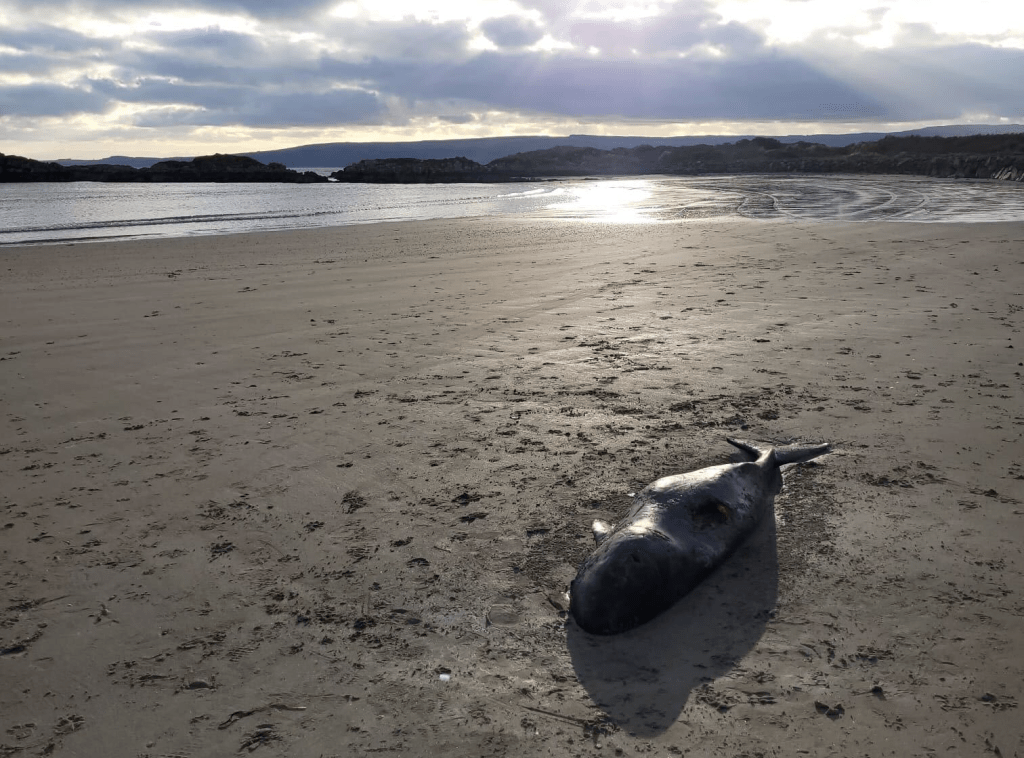
The body of a female narwhal, a species never before seen in Irish waters, was found washed up on Sweet Nellies Beach in northeast Donegal, the National Parks and Wildlife Service (NPWS) confirmed Friday.
The creature was discovered the previous weekend by a family walking the beach who reported finding a 2-3m whale or dolphin carcass to the Irish Whale and Dolphin Group (IWDG).
After retrieving the body Sunday morning, IWDG and NPWS confirmed it to be a young female narwhal that had died recently beforehand, potentially even after washing ashore.
Niall Ó Donnchú, Director General of the NPWS called the discovery “an extraordinary and unprecedented event.”
Narwhals are toothed whales found in the Arctic Circle, north of 60 ° in latitude, and very rarely seen elsewhere. This is only the tenth recorded stranding of a narwhal in northwestern Europe.
Male narwhals are noted for their prominent singular tusks, often being called “unicorns of the sea.” Such tusks are very rare in females though, and there was none present on the carcass found in Donegal.
Minister for Nature, Heritage and Biodiversity Christopher O’Sullivan TD spoke about the discovery shortly afterwards, saying:
“I’d like to thank everyone who was involved in retrieving the stranded Narwhal for their rapid response and collaboration, from the young people who initially spotted it on the beach and raised the alert, to the dedicated teams in the Irish Whale and Dolphin Group, the Regional Veterinary Laboratory in Cork and the National Parks and Wildlife Service of my own Department.”
“This is a significant event and it is important that we try to find out more about why this species arrived on our coastline. An examination is underway which I hope will reveal important details about its life and history, and shed some light on the reasons why it arrived on our shores. The Narwhal is an arctic species that is mainly found in cooler waters. Findings like this are a stark reminder of the vulnerability of wildlife in the face of a changing climate, and the need to protect them.”
Simon Berrow, CEO of IWDG, is also concerned about the climatic implications of such a discovery:
“It’s a remarkable stranding. As our waters warm we have seen a northern movement of whales and dolphins in Irish waters as fish move north seeking cooler waters. To have an Arctic species stranded for the first time is somewhat unexpected. However we recorded another Arctic species, a bowhead whale, in Ireland for the first time in 2016 so maybe this reflects a breaking down of Arctic ecosystems as the ice melts, he said.”
“Clearly one stranding cannot display any trends but it does show the importance of our long-term monitoring schemes and the power of citizen scientists sending these reports to the IWDG.”
Despite future concerns for habitat, narwhals are not currently endangered. They are listed as “of least concern” by the International Union for Conservation of Nature, with approximately 170,000 living worldwide.