


By Hailey Cassidy
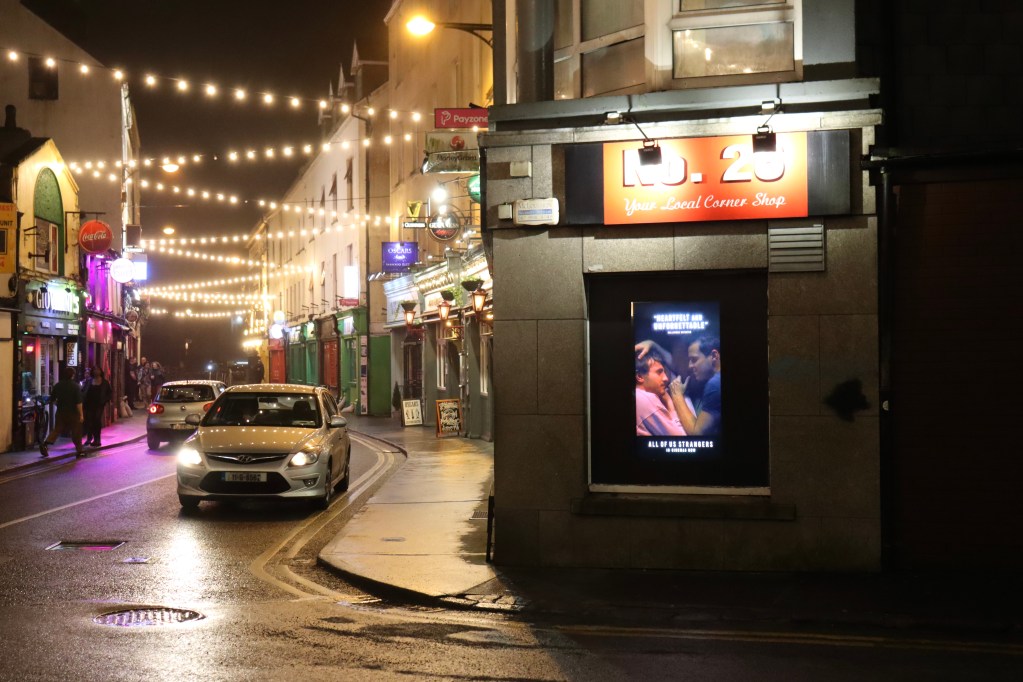
There is a lot to say about director Andrew Haigh’s latest critically-acclaimed film All of Us Strangers, which is a story about a man who has a lot to say.
Much of the discourse around the movie has been focused on the “certified internet darlings” Andrew Scott and Paul Mescal; how the Irish actors are redefining masculinity or Mescal’s performance in such intimate gay sex scenes as a hetero heartthrob. Dr Páraic Kerrigan, Assistant Professor in the School of Information and Communication Studies at University College Dublin, sees a different cultural significance in All of Us Strangers.
Dr Kerrigan is also the author of the book LGBTQ Visibility, Media & Sexuality in Ireland. His upcoming book Reeling in the Queers: Tales of Ireland’s LGBTQ Past will be released in June.
“The queer experience and the queer childhood and the queer Irish childhood: it’s often about silences, it’s often about gaps, it’s often about the what is not said between the family, the maintenance of the lace curtain respectability, brushing everything under the carpet, sexualities untold,” he says.
“But Andrew Scott gets the opportunity to go back to his parents at a particular point in time, who can identify that their child is somewhat fey, somewhat different, somewhat other, minoritised, and actually gets to confront them on their inadequacies, their issues, their perspectives.”
“That’s where I think the movie is actually revolutionary: affording a queer character … to confront a lost childhood, reclaim it to a degree, and I suppose negotiate all of these disparate aspects around queer sexuality in the 1980s, with his parents, in a very loving way that results in acceptance,” says Dr Kerrigan.
“It’s different now,” Adam (Andrew Scott) tells the ghost of his mother (Claire Foy).
“Well, I guess I wouldn’t know anything about that,” replies his mother, who died in the 1980s.
It certainly is different now for same-sex couples, as Adam continues to assure his parents throughout the rest of the film. But a more open-minded, inclusive modern era has not in and of itself healed Adam’s trauma of growing up in the previous generation. The movie’s main message is this: though things are different, and though a lot of time has passed, there is still a lot of rot that lies underneath.
All of Us Strangers is a story about grief, loneliness, and hidden pain: including the pain that is invisible within rapidly liberalised queer spaces. The story is set in London, but with both leads being such prolific Irish idols, it calls to mind what (or who) has been disregarded in the gender and sexuality rights revolution in famously progressive, post-Catholic Ireland.
Ireland’s own history
While Ireland was one of the last states in Europe to decriminalise homosexuality, it was the first country in the world to introduce same-sex marriage through a national referendum vote. The liberal victory in 2015 proved to the world that Ireland had shifted from a conservative, insular state on the edge of Europe to a modern and inclusive republic.
Looking at the demographics, 62 per cent of the population was strongly opposed to homosexuality in 1981, but this had dropped to 38 per cent by 2000.
The Celtic Tiger, the collapse of the authority of the Catholic Church and integration into the European Union are all considered to have contributed to a precipitous change in social values.
Just a few months after the amendment to the Constitution passed to permit same-sex marriage, the Oireachtas passed the Gender Recognition Act 2015, which permits Irish citizens to change their gender on government documents. And in 2017, Leo Varadkar made history by becoming Ireland’s first openly gay head of Government.
“These events all become corroborated towards demonstrating Ireland as this post-Catholic nation that is a liberal enclave of free desire: a liberal enclave that, demonstrably, all differences are ‘of yesterday’ and it is very much an accepting society where minorities are freely accepted,” says Dr Kerrigan.
He continues: “You see this with the likes of Leo Varadkar being on the cover of TIME magazine in 2017: an island at the centre of the world. So this is the global impression that is being constructed around Ireland by Ireland itself, but also by international news media that is kind of holding up Ireland as this boilerplate of what ‘good’ looks like in terms of liberal queer politics.”
“And that’s very limiting in terms of the kind of liberation that that offers and the kinds of queerness that it defines,” says Dr Kerrigan.
Liberation’s limitations
Dr Kerrigan references the letter to Kylie Minogue that Mr Varadkar wrote in 2019 and the way it was portrayed in the Irish mainstream press.
“He becomes framed as this sycophantic gay fan in a stereotypical kind of obsessive way, when it wasn’t necessarily the case when you see the likes of Enda Kenny, the previous Taoiseach, writing letters to Bruce Springsteen,” he says. “The dynamic is different because Leo Varadkar is a gay man writing to Kylie Minogue. That’s reflective, broadly, of the kinds of undercurrents of homophobia that we’re seeing in Irish society.”
“I know many people who have the best of intentions in terms of their liberation politics and in terms of being inclusive and diverse, but in practice,” says Dr Kerrigan, “they might do that would be somewhat a slight against the community. I’m even regularly being asked, myself and my husband: ‘Who’s the wife?’”
“You get these gendered kinds of components positioned upon you. And while the intent is not bad, the impact isn’t great,” he says.
As Adam puts it in All of Us Strangers: “It’s funny – things are better now, of course they are – but it doesn’t take much to make you feel the way you felt.”
The conditions of the marriage referendum
Dr Kerrigan also speaks of the conditions of the 2015 marriage referendum and how it was designed to pass. He explains that the campaign for the amendment positioned lesbian and gay identities centrally within the campaign, while excluding other queer identities.
According to Dr Kerrigan, “What you see in terms of mainstream acceptability is a politics of respectability whereby gay and lesbian lives are generally white, they are settled people, and they have a white picket fence. And they want the same things that you straight people have.”
“The alternative modes of developing family, such as the alternative modes and the ways in which we have sex, the alternative modes and the ways in which we engage with each other via different relationship dynamics: those were not considered palatable for mainstream Irish society in terms of getting a referendum passed,” he says, nor “even just simply including bisexual people in the campaign”.
“There are a lot of issues still around assimilatory politics, around having respectability,” says Dr Kerrigan. “But oftentimes respectability and assimilation in neoliberal society are the costs to gain access to these kinds of technocratic institutions, these kinds of civil institutions that are often led through capitalistic imperatives and what not.”
Liberation is more than legislation
Last September, a Cork bar “removed all traces” of their 17-year long history as a beloved gay bar. All flags and memorabilia were taken down and signs were painted over, in an effort that was widely believed to be designed to make more money during Freshers Week by rebranding as a straight bar.
Earlier in the summer, protestors interrupted a daytime Drag Story Hour at a library in Cork, with analysts saying that protests against LGBTQ+ events and books in Ireland are imports from the far-right in the United States.
And in October, a young man was sentenced to life in prison for the murder of two gay men in Sligo.
“There’s been a resurgence of hate kind of stuff, especially in the big cities like Dublin,” says Brian Tuohy, who has worked at Bar Nova, Galway’s only gay bar, since last year. Behind him, drag queen Devon Diva is the DJ for the evening.


“I feel like most people are accepting now and they understand that times are different,” Mr Tuohy says. “I find working here, it’s really open and accepting. Everyone that comes in, they’re always nice and friendly.”
But when asked if he thinks it’s difficult for queer people to come out in Ireland today, he answers: “For some people. It depends on their background and where they’re from.”
“Some families are still very religious. My own family is very religious,” Mr Tuohy says. “Rural Ireland sometimes in places can be a lot more slow to acceptance and change and all that compared to the cities.”
Next month’s referendum
Four years after the last referendum, which amended divorce law, the upcoming referendum on 8 March that would revise the definition of family and the debate surrounding it has put on display the current ceiling on progressivism and gender equality in Ireland.
The March referendum is seen by many as another effort by Government to extract things from a bygone era and the remnants of the Church within the Constitution. But there are also many who are averse to the suggestion to de-gender the language of the fundamental law of Ireland.
This month, groups such as The Countess have been protesting in Dublin. They feel that the proposed changes are an insult to Irish women and mothers.
The Countess is an anti-transgender group which organised the ‘Let Women Speak’ rally this summer.
They advocate for a trans-exclusionary version of feminism, putting out statements such as: “safety and fairness are being compromised by males in women’s sport” and “lesbians are being pressured into transition or accepting males as partners”.
A Newstalk Amárach poll in November found that over half (51 per cent) of respondents said that people should only use the toilets or other “gendered spaces” of their biological sex at birth. The survey also found that 40 per cent of people do not believe transgender athletes should be allowed to compete in the gender they identify with.
Dr Kerrigan says, “We have not necessarily done all that we can in terms of ensuring an inclusive Ireland.”
“It is far better than many other places in Europe and the world, but it has its problems. Everything is not solved. There’s a lot of work to do still: especially in terms of developing coalitions and working alongside our trans brothers and sisters who are very much suffering.”